End to End Testing

Maximize test coverage and reliability with our end-to-end testing solutions

Infodecimal team meeting on end-to-end testing process for software quality assurance

We specialize in End-to-End Testing to validate every component of your software across real-world scenarios. From user interfaces to back-end processes, third-party integrations, and system workflows, we ensure that everything works together seamlessly. Our comprehensive approach helps businesses mitigate risks, improve software quality, and enhance user experience. Our meticulous validation process guarantees that your applications function as intended, even in the most complex environments.

Optimize every user journey with our precise and well-defined end-to-end testing processes.

  • Holistic Quality Assurance Framework: Leverage our comprehensive validation approach, ensuring exhaustive verification of all features, workflows, and integrations, leaving no room for undetected defects.
  • Defect Prevention & Early Risk Mitigation: Our proactive shift-left testing strategies identify and resolve functional discrepancies at the earliest stages, significantly reducing critical software failures.
  • User-Centric Performance Assurance: We ensure a seamless, intuitive, and responsive user experience through meticulous validation, aligning software behavior with real-world user expectations.
  • Unique Test Engineering Strategies: Our context-driven testing methodologies adapt to your specific business requirements, delivering precision-crafted validation frameworks for optimal software reliability.
  • Data-Driven Testing Intelligence: Gain deep analytical insights and predictive defect analytics through our structured reporting, empowering you with actionable data to enhance software stability and performance.

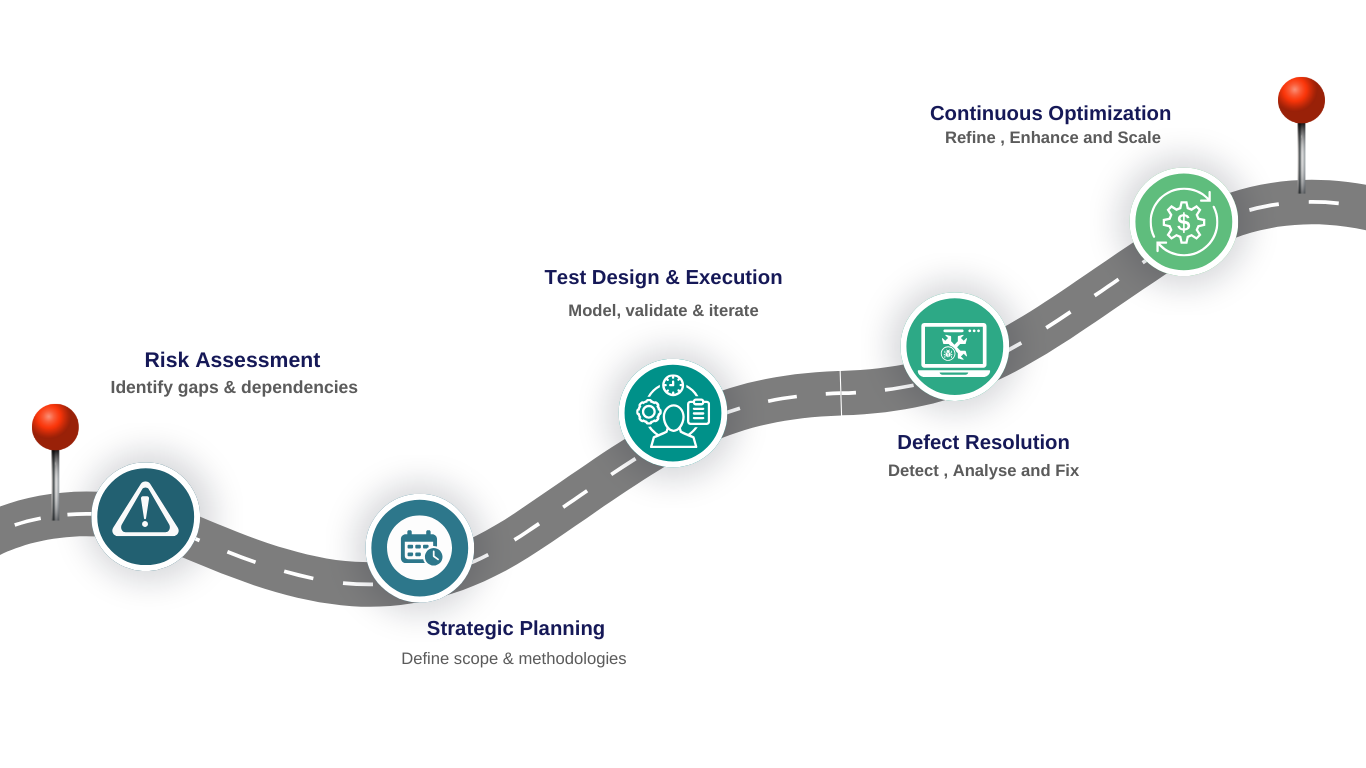
A Structured 5 Stage Validation Framework
Challenges and Solutions

Achieving full coverage requires a risk-based testing approach, where test scenarios are mapped to business-critical workflows. Implementing traceability matrices helps link test cases to requirements, ensuring no functionality is overlooked. Additionally, data-driven testing allows comprehensive validation of various user inputs and conditions.

End-to-end testing often faces roadblocks due to external dependencies. Service virtualization and mocking techniques can simulate third-party services, ensuring uninterrupted testing. Additionally, contract testing can validate integrations independently, reducing dependency failures while maintaining test accuracy.

Slow and unstable tests often result from poor test data management and long execution cycles. By implementing parallel execution on cloud environments, tests can run simultaneously across multiple configurations. Additionally, using self-healing test automation frameworks helps reduce failures caused by dynamic UI changes, improving reliability.

Shifting testing left in the SDLC enables early defect detection. Continuous integration with automated smoke tests can catch regressions before they impact production. Also, implementing static code analysis, unit tests, and API testing early helps prevent defects from propagating into later stages.

Inconsistent environments cause false positives and negatives in test results. Leveraging infrastructure as code (IaC) ensures that test environments can be provisioned identically every time. Additionally, using containerized environments (Docker/Kubernetes) helps maintain uniformity across development, testing, and production environments.

As applications grow, test execution time can become a bottleneck. Modular test architectures break large test suites into manageable, reusable components. Leveraging cloud-based execution platforms allows for distributed testing, reducing execution time. Additionally, test data partitioning and synthetic test data generation help manage scalability effectively.

UI instability often leads to test failures due to frequent DOM structure changes. Implementing AI-driven element identification helps dynamically locate UI elements even when attributes change. Using robust locator strategies (ARIA labels, XPath relative positioning, and visual testing) makes tests less dependent on UI modifications, ensuring stability.

Gathering meaningful insights requires AI-driven test analytics and predictive defect analysis. By integrating custom dashboards and real-time reporting, teams can identify failure trends, prioritize test efforts, and optimize future releases. Additionally, leveraging test coverage heatmaps and KPI-driven reporting helps track progress and improve test effectiveness.

Ready to supercharge your business with our top-tier software testing?